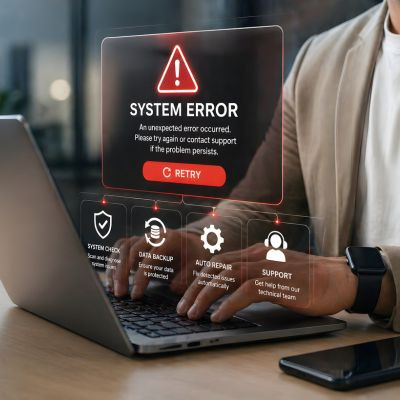


“Persuasion.” “Percussive Maintenance.” Whatever you call hitting your computer to make it work, we get it. We’ve all been there. Your Wi-Fi router drops the signal for the third time during a meeting, or your TV remote decides to go on strike. In a fit of frustration, you give it a firm slap; and miraculously, it starts working again.
BlackCSI Blog
The purpose of your business is to deliver goods or services to your target customers or clients. To this end, you can use technology to dramatically improve operations and create a better product for your consumers. Let’s discuss how you can use technology to build better internal practices to in turn create a better customer experience.
Few things in the office are as frustrating as Internet connectivity issues, right? The router is right there, you seem to have a strong Wi-Fi signal, but your virtual meeting keeps disconnecting. What gives?
The reason is simple: a signal’s strength isn’t the same as how much information can get through. The difference is key to focusing on the right metrics and—most importantly—ensuring your team can work the way they need to.
In IT services, we often use the iceberg analogy to describe the Internet. The Surface Web, the sites you browse daily, is just the 10 percent visible above the waterline. Below that lies the Deep Web, and at the murky bottom is the Dark Web.
For a business owner, the Dark Web isn’t just a concept from a spy movie; it is a sophisticated, unregulated marketplace where your company’s data is the primary commodity (and target). If your information is down there, it’s not a matter of if someone will use it, but when.
Most businesses don’t have what it takes to survive a hardware failure or natural disaster, and we don’t mean in terms of “grit.” What we mean is in the sheer technological capacity to recover their data and continue operations. It’s bizarre, too, how easy data backup can be, provided you follow these three key tenets. With a little help from a qualified backup professional, your business can stay resilient even in the worst of times.
The conversation around B2B data security is no longer about having a backup, but about whether your backup actually works when you need it most. Data backup and disaster recovery solutions were once seen as “set it and forget it” tools, but this is no longer the case. In reality, your data backup strategy is much more complex, and if you fail to give it the attention it deserves, it could result in an extinction-level event for your business.
Sometimes the scariest part of running a business is not knowing what tomorrow will bring, particularly when it comes to your IT. Break-fix IT is one of the leading causes of anxiety amongst small business owners, but it doesn’t have to be. Managed IT offers a reprieve from the chaos and the unknown so you can be confident about the direction your business is heading.
IT is more than a necessary expense; it’s a tool to get your business into a more advantageous position, one where you can make more money and help more people. The only way you can get to this point, however, is if your IT is yielding a return on your investment; otherwise, it will always feel like a money pit.
With the new year just around the corner, you’re probably wondering what the latest cybersecurity threats will have in store for small businesses like yours. One such threat is the rise of agentic AI, which capitalizes on the weakest link in any business’ cybersecurity infrastructure: its human elements. If you already have a hard time figuring out if the person on the other end of the phone line is human, just wait… It’s only going to get worse.
Prevention is better than a cure, as it prevents your business from ever experiencing the problem in the first place. This is especially true for your technology. When businesses invest in IT, they can do so for one of two reasons: they are repairing problems that are costing them in downtime, reputation, and capital, or they are actively preventing those problems through smart implementation of IT. Which side do you want to be on?
We offer preventative services that can help you control the cost of your IT solutions like never before, and here’s how we do it.
We’ve all been there: frustrated by the difficulty of installing new software, dealing with licenses that suddenly expire, or constantly needing to upgrade outdated tools just to keep them running. These are classic headaches that come with buying and owning software licenses. Thankfully, there’s a much smarter way to handle things: Software as a Service, or SaaS.
Technology is a double-edged sword: it supercharges business efficiency but also equips organizations like law enforcement with unprecedented power. Setting aside the immediate ethical debate, it is crucial to understand the sophisticated technologies certain agencies are leveraging in their operations; specifically, the advanced AI and data-mining platforms, such as those created by Palantir.
Be honest: Do you have a real plan for the day your server goes dark? We're not talking about a little glitch—we mean a full, sudden stop due to a failed disk, a nasty strain of ransomware, or an accidental keyboard slip. For too many businesses, the "plan" is just that dusty external drive they plug in at closing time. This isn't a strategy; it's a prayer, and one that will go unheard when you need it most.
That false comfort is your biggest IT blind spot, because if a simple copy-paste job was enough, we wouldn't see businesses vanish after a single data incident. Stop crossing your fingers and let's get you a recovery plan that actually works.
It's one of the most recognizable icons in modern digital design: three short, horizontal lines stacked neatly together. You've seen it countless times, representing the main menu on nearly every website and application. Sometimes it transforms into three dots—a "kabob" menu, if you want a fun fact, but its function remains the same: it's the gateway to everything your site has to offer.
For all its benefits, remote work has certainly created some challenges. One major issue is the lack of visibility you have over your employees and the ramifications that could result.
While it is critical to cultivate trust in and with your employees, you also need tools to monitor progress and hold your team members accountable. Let’s talk about some of the issues you may discover once we give you the visibility you need.
Manufacturing equipment costs a pretty penny, so you naturally expect it to drive profits and yield a return on investment. Yet, how often do these machines break down and cost you more than they should? By the time the red light turns on that tells you something’s wrong, you’ve already wasted precious time that you could have been saving with proactive, preventative maintenance.
Many businesses think of IT as nothing but an expense, often represented by losses on your budgeting reports. You might dump countless dollars into your IT only for it to eat it all up without providing any discernible return on investment. Here’s the truth about IT: when it’s managed properly, it can represent opportunity and investment rather than expense.